Continuous vs. Non-Continuous OBD2 Monitors: Full Guide
When preparing our vehicles for mandatory state emissions inspections, deciphering diagnostic monitor readiness statuses can feel confusing and overwhelming. We often see motorists assume that every internal self-test operates continuously whenever the engine is running. In reality, the onboard diagnostic system divides emissions monitors into two distinct operational categories that evaluate hardware very differently. Understanding the distinction between continuous and non-continuous monitors helps us identify pending mechanical faults and pass smog tests without wasted effort. In this guide, we break down how both monitor types function, why specific tests fail, and how to verify compliance quickly.
https://01f7eqj-s6arhz9aqq8nz9xm75.hop.clickbank.net
Key Takeaways
Continuous monitors evaluate engine misfires, fuel trim balance, and comprehensive electrical components constantly during every trip.
Non-continuous monitors evaluate emissions hardware like catalytic converters and evaporative systems only under strictly controlled driving conditions.
All continuous monitors must report ready for emissions inspections, whereas many states allow one non-continuous monitor to remain incomplete.
Differences Between Continuous and Non-Continuous Monitors
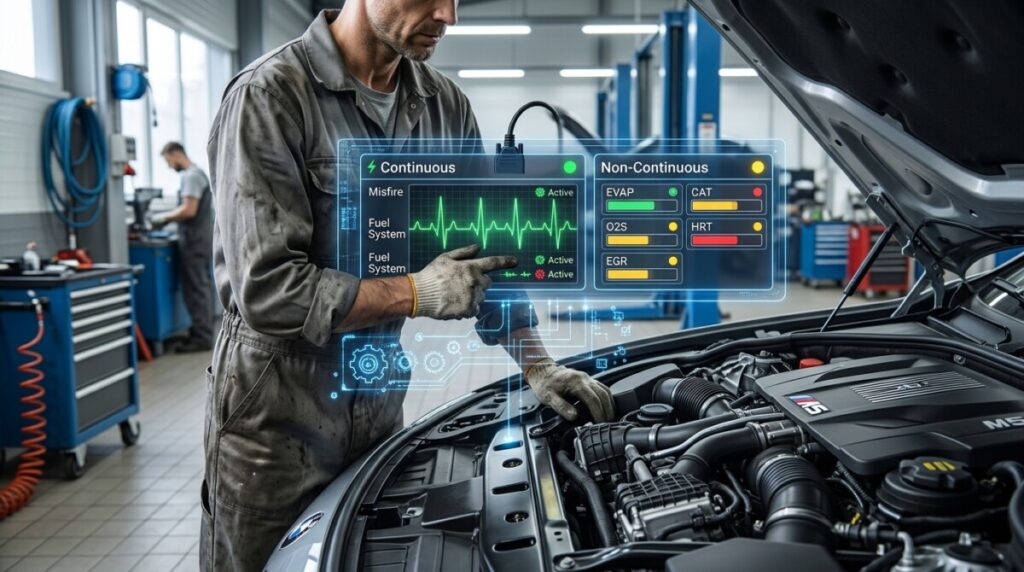
The powertrain control module runs continuous monitors indefinitely whenever the ignition engages to safeguard internal engine components (Society of Automotive Engineers, 2021). These continuous routines constantly track cylinder misfires, fuel trim balances, and sensor circuit performance across every driving cycle (U.S. EPA, 2020). Conversely, non-continuous monitors evaluate auxiliary emissions systems, including catalytic converters, oxygen sensor heaters, and evaporative canisters (California Air Resources Board, 2022). Rather than running constantly, non-continuous tests trigger only when engine temperatures, road speeds, and fuel levels satisfy strict parameters (Bosch Mobility Solutions, 2023). Diagnostic testing confirms continuous monitors establish readiness within minutes, whereas non-continuous monitors demand multi-stage driving cycles (National Institute for Automotive Service Excellence, 2022).
https://ea391pu8t33vfs9ate1ozm3s3z.hop.clickbank.net
Why Non-Continuous Monitors Fail to Set Ready Status
Motorists often discover that non-continuous monitors refuse to set ready status because modern engine computers enforce rigid diagnostic criteria (Delphi Technologies, 2021). For example, the evaporative monitor aborts self-testing if ambient air temperatures drop below 40 degrees or exceed 90 degrees Fahrenheit (Environmental Protection Agency, 2021). Furthermore, fuel levels outside the 15 to 85 percent threshold prevent the powertrain computer from running internal pressure tests (Motor Age Magazine, 2023). Drivers also create unexpected delays by clearing trouble codes, which erases diagnostic memory and resets every monitor to incomplete (Automotive Service Association, 2022). Minor issues like sluggish oxygen sensors or microscopic vacuum leaks often suspend testing without illuminating the check engine light (Society of Automotive Engineers, 2023).
How to Ready All OBD2 Monitors for Inspection
Automotive technicians ready stubborn non-continuous monitors by executing manufacturer-specific drive cycles that replicate diverse city and highway operating demands (General Motors Service Operations, 2022). A standard test cycle requires an overnight cold engine soak followed by steady cruising between 45 and 55 miles per hour (Ford Technical Service, 2023). Decelerating down to 20 miles per hour without touching the brake pedal enables the computer to verify exhaust gas recirculation flow (Toyota Technical Training, 2021). Professional shops now utilize bi-directional scan tools to command valves and verify circuits within 15 minutes without road travel (Snap-on Diagnostics, 2024). Future emissions regulations anticipate connected vehicle telematics will verify monitor readiness wirelessly in real time, eventually eliminating physical testing stations altogether (Connected Vehicle Trade Association, 2024).
Conclusion
Distinguishing between continuous and non-continuous OBD2 monitors allows us to approach emissions testing with strategic clarity rather than unnecessary anxiety. We have learned that while continuous systems constantly protect engine mechanical health, non-continuous monitors require disciplined driving conditions to complete their evaluations. Recognizing these operational differences prevents motorists from wasting fuel on aimless highway miles while attempting to satisfy complex readiness algorithms. Proper monitor management not only ensures clean regulatory compliance but also protects our environment by guaranteeing optimal exhaust purification across every trip. Before taking your vehicle to an inspection station, we strongly recommend scanning your readiness monitors to verify your compliance status ahead of time.
https://mechanics.stackexchange.com/
https://holisticwellnesswave.com/index.php/2024/02/21/initiative-a-key-element-for-career-success/
Frequently Asked Questions
https://82e60ov5l5zyjq3qxdj7qa69ae.hop.clickbank.net
Can I pass inspection if a continuous monitor is incomplete?
No, you cannot pass an emissions inspection if any continuous monitor is incomplete. State testing programs require the misfire, fuel system, and comprehensive component monitors to report ready on every vehicle. An incomplete continuous monitor signals active diagnostic communication problems or an unresolved power reset.
How do continuous and non-continuous monitors differ in operation?
Continuous monitors operate constantly whenever the engine runs, immediately flagging ignition misfires, abnormal air-fuel mixtures, and sensor circuit faults. In contrast, non-continuous monitors evaluate auxiliary emissions systems, such as the catalytic converter and evaporative canister, only after specific vehicle speeds, temperatures, and fuel levels are achieved.
How many non-continuous monitors can remain not ready to pass?
Under federal EPA regulations, passenger vehicles from model year 2001 and newer can pass emissions with one incomplete non-continuous monitor. Vehicles built between 1996 and 2000 are allowed up to two incomplete non-continuous monitors, provided the check engine light remains off during testing.