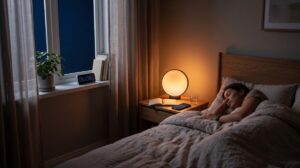
Circadian Rhythm Lighting: Improve Sleep Architecture

We spend over ninety percent of our modern lives indoors under static artificial illumination that completely disrupts our evolutionary biology. In our fast-paced society, chronic sleep fragmentation and daytime fatigue have become normalized health crises rather than recognized warning signs. By examining how artificial light frequencies misalign our internal clocks, we can finally solve persistent sleep quality issues at their root cause. Restoring dynamic environmental illumination offers a non-pharmacological pathway to strengthen restorative rest and daytime vitality. Let us explore the scientific principles behind tunable indoor light and its measurable influence on overnight sleep cycles.
https://e9e03cy4ld7pno993b1303ez9v.hop.clickbank.net
Key Takeaways
Circadian rhythm lighting regulates the master biological clock by stimulating melanopsin-containing retinal ganglion cells with specific blue wavelengths.
Evening exposure to high melanopic lux suppresses pineal melatonin secretion and delays transitions into restorative slow-wave sleep.
Tunable dynamic lighting protocols must account for user chronotypes, daytime daylight intake, and fixture placement to avoid counterproductive glare.
Biological mechanisms of circadian rhythm lighting
Biodynamic lighting functions by directly stimulating intrinsically photosensitive retinal ganglion cells that express the photopigment melanopsin. These non-visual photoreceptors respond maximally to cyan-blue wavelengths between 460 and 490 nanometers, sending photic neural signals directly along the retinohypothalamic tract to the suprachiasmatic nucleus. Daytime exposure to bright light with high melanopic equivalent daylight illuminance vigorously suppresses daytime melatonin while elevating morning cortisol to anchor internal phase timing. Conversely, shifting to low-intensity, red-enriched light below 2,700 Kelvin in the evening permits the pineal gland to synthesize melatonin unhindered. Clinical polysomnography demonstrates that this natural hormonal transition preserves healthy sleep architecture by accelerating rapid eye movement latency and extending restorative slow-wave delta sleep.
Physiological limitations and environmental trade-offs of biodynamic light
https://01f7eqj-s6arhz9aqq8nz9xm75.hop.clickbank.net
Despite its compelling theoretical promise, implementing circadian lighting systems introduces biological variability, optical limitations, and significant behavioral trade-offs. Inter-individual differences in age, crystalline lens yellowing, and pupil dynamics mean two occupants exposed to identical ambient fixtures can absorb vastly different retinal illuminance levels. A major clinical study from the Lighting Research Center highlighted that daytime outdoor daylight exposure of roughly one hour often overrides subtle indoor lighting interventions entirely. Furthermore, aggressive blue-enriched morning fixtures often produce severe direct glare, headaches, and visual fatigue in desk workers situated close to ceiling luminaires. Extreme evening dimming protocols can also impair visual safety and task performance for shift workers and older adults prone to accidental falls.
Practical lighting protocols for deep sleep architecture
Maximizing real-world benefits requires implementing automated spectral-tuning schedules synchronized with architectural daylight patterns and personal work routines. Smart building managers increasingly deploy luminaires delivering 250 melanopic daylight lux at eye level throughout the morning, followed by a gradual reduction to under 10 melanopic lux two hours prior to bedtime. Homeowners can replicate this physiological cycle using automated smart bulbs that transition from 5,000 Kelvin daylight white during peak working hours to a warm 1,800 Kelvin ember glow at dusk. Looking ahead, next-generation solid-state fixtures will integrate closed-loop physiological sensors to dynamically modulate individual spectral output based on real-time biometric strain and room occupancy. These integrated environmental interventions establish a reliable circadian rhythm that stabilizes sleep architecture without relying on prescription sedative aids.
Conclusion
Our modern understanding of photobiology proves that light is not merely a tool for vision, but a potent biological regulator of human health. We must recognize that our bodies depend on distinct daytime and nighttime environmental cues to coordinate critical physiological recovery processes. By aligning our indoor lighting systems with natural solar cycles, we can protect our sleep architecture from chronic artificial disruption. We recommend automating your home light spectrums to warm amber tones after dusk to experience deeper and more restorative sleep.
https://holisticwellnesswave.com/index.php/2025/11/18/digital-mental-health-solutions/
https://serenity7wellness.com/index.php/2026/01/08/cozymaxxing-sleep-mood-enhancing-tips/
Frequently Asked Questions
What is circadian rhythm lighting and how does it work?
Circadian rhythm lighting uses tunable fixtures to replicate the natural progression of outdoor sunlight throughout the day. It emits blue-enriched wavelengths during morning hours to boost alertness, then automatically transitions to warm, amber illumination in the evening to allow uninterrupted melatonin production for sleep.
How does artificial night light disrupt healthy sleep architecture?
https://c4caccobrzz3jyd5tdwitc0ra2.hop.clickbank.net
Evening exposure to blue-wavelength light stimulates melanopsin receptors in your eyes, signaling the brain that it is still daytime. This suppresses natural melatonin release, prolongs the time needed to fall asleep, and significantly curtails both restorative slow-wave sleep and critical rapid eye movement stages.
How can someone adjust home lighting to improve deep sleep?
Replace cool white bulbs in bedrooms and living rooms with warm-spectrum LEDs rated under 2,700 Kelvin. Dim indoor fixtures two hours before bedtime, install automated color-shifting lamps, and prioritize at least twenty minutes of direct morning sunlight exposure immediately upon waking each day.